We pulled a broken pair of springs off a two-car door in Farmington this week. Customer asked the question we hear all the time: “Is there anything better than what I had, so this doesn’t happen again?”
The short answer is yes — high-cycle springs exist, and for some households they’re a smart upgrade. But they’re not always worth the extra money. Here’s the honest breakdown.
How long a garage door spring is actually supposed to last
Spring life isn’t measured in years — it’s measured in cycles. One cycle is one full open + one full close. A standard torsion spring is rated for around 10,000 cycles.
That sounds like a lot until you do the math. A household that uses their garage as the main door — in and out for work, kids, errands, groceries — averages 3 to 5 cycles a day. At 4 cycles a day, a 10,000-cycle spring gives you about 6 to 7 years. Lighter use will get you closer to 10. Heavier use — teenagers, home-based businesses, a second driver on the same door — can burn through them in 4 or 5.
When a spring “breaks early,” it usually didn’t. It hit its cycle count. The owner just didn’t realize how many times the door was going up and down.
Why Minnesota is harder on springs than most places
Cold garages are rough on spring steel. A torsion spring flexing at -10°F doesn’t behave the same as one flexing at 60°F, and the Twin Cities put springs through 60° and 70° temperature swings in a single day during shoulder seasons. That thermal stress, combined with any moisture or salt that rides in on the car in winter, accelerates both fatigue and surface rust.
It’s also why we see so many failures happen on the coldest morning of the year — the spring was already at the end of its life, and the cold just finished the job.
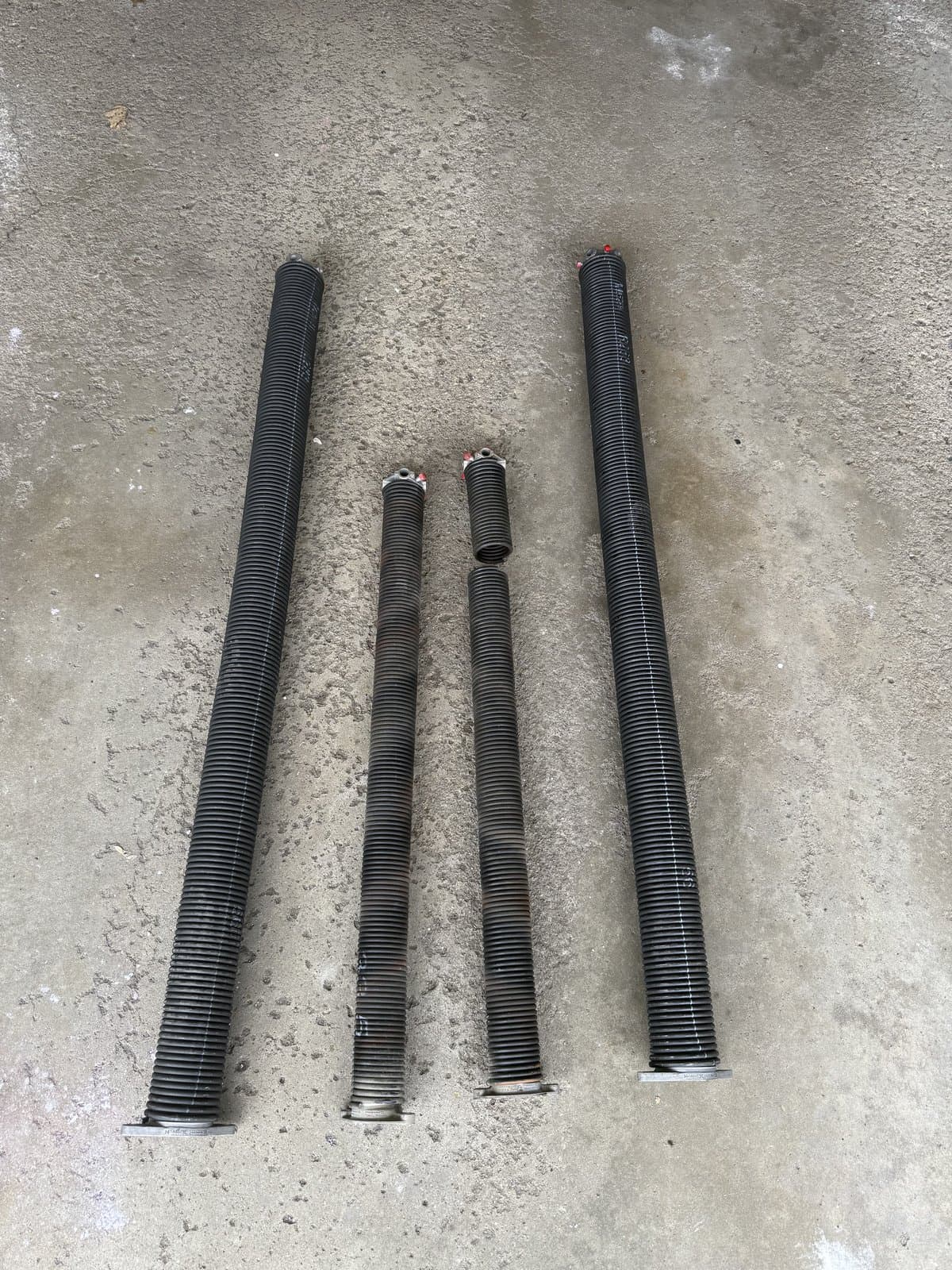
The two shorter springs in the middle are a broken standard pair. The two longer ones on the outside are the high-cycle replacements we installed.
What “high-cycle” actually means
High-cycle springs are the same basic torsion spring — wound steel, mounted the same way — but built with thicker wire and a longer coil so the metal works less for each open-close. Common ratings:
- 20,000 cycles — roughly 2× a standard spring
- 30,000 cycles — about 3× standard
- 50,000–100,000 cycles — commercial-grade, overkill for most homes
They install the same way a standard pair does. Same shaft, same brackets in most setups, same labor time. The visible difference is the length — a 20k-cycle spring is noticeably longer than the 10k it replaces, which is why you can sometimes tell at a glance which version is on a door.
When high-cycle springs are worth the upgrade
We recommend high-cycle without hesitation in a few situations:
- Heavy daily use — two drivers on the same door, teenagers, a garage that doubles as the main entry. If you’re opening and closing 6+ times a day, standard springs are the wrong tool.
- Your last set died early. If you’ve had a spring replacement inside 5 years, you’re underspec’d. Upgrading once is cheaper than replacing a standard pair three more times over the next decade.
- There’s a living space over or next to the garage. Heavier-wire springs make the door quieter and smoother, which matters if there’s a bedroom, office, or home gym near it.
- Rental or short-term-rental properties. Fewer callbacks. Worth the math.
When they’re not worth it
We talk customers out of high-cycle upgrades too, because sometimes the standard pair is genuinely the better buy:
- Light use. One driver, once or twice a day, door is mostly an afterthought — a standard spring will give you 10 good years. Spending 40% more for a spring you won’t outlive doesn’t make sense.
- You’re selling the house soon. A buyer doesn’t know or care whether the spring is 10k or 20k rated. They want a door that works.
- Budget is tight. A fresh standard spring properly sized and balanced is still a good repair. Don’t let anyone upsell you into something you don’t need.
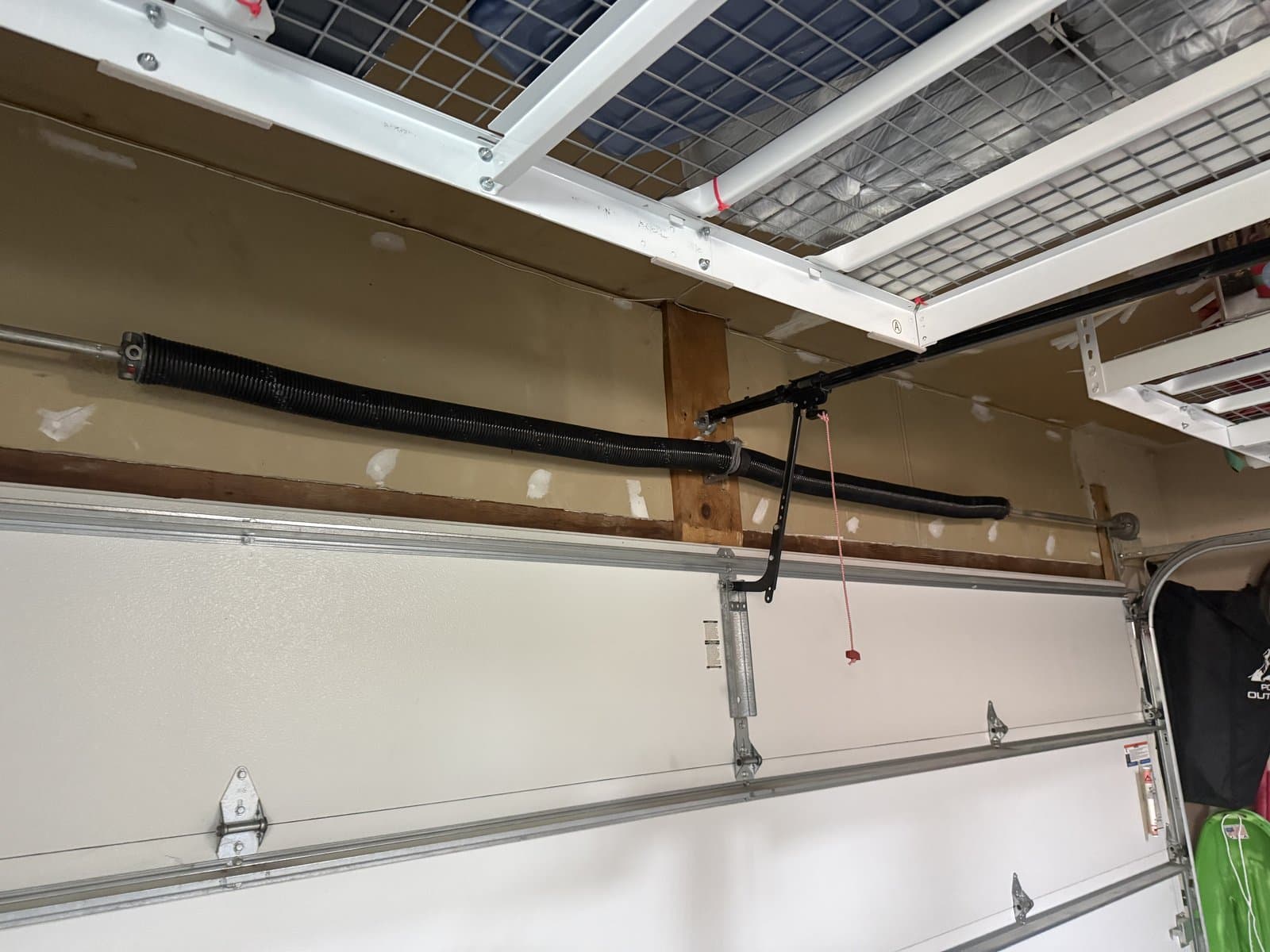
High-cycle pair installed on the spring line. Same mounting, same shaft — just thicker wire and a longer coil than the standard springs they replaced.
The catch: cost and sizing
High-cycle springs run roughly 30–50% more per spring than standard. Installation labor is the same. If your last standard replacement was $300 in parts, expect $400–$450 for a 20k-cycle pair and a bit more for 30k.
One thing to watch: not every door can take every spring size. The shaft length and wall space around the spring line have to accommodate the longer coil. On most residential doors it’s a drop-in swap. On a few tight installations we have to get creative, which is a conversation to have during the quote, not after the install has started.
Our honest recommendation
Do the math first. If your last set of springs lasted 8+ years and you’re happy with the door, stay with standard — you’re not the market for high-cycle. If the set that just broke was less than 5 years old, or if you know your household is hard on the door, upgrade. The payback is clear inside one spring lifetime.
If you’re in Farmington, Rosemount, Apple Valley, Lakeville, or anywhere in the south Twin Cities and aren’t sure which makes sense for your setup, call or text us — we’ll quote both options and give you the cycle math for your specific door. No pressure either way.